
Quintessence

 Already started - ends in 14 d. 4 h.

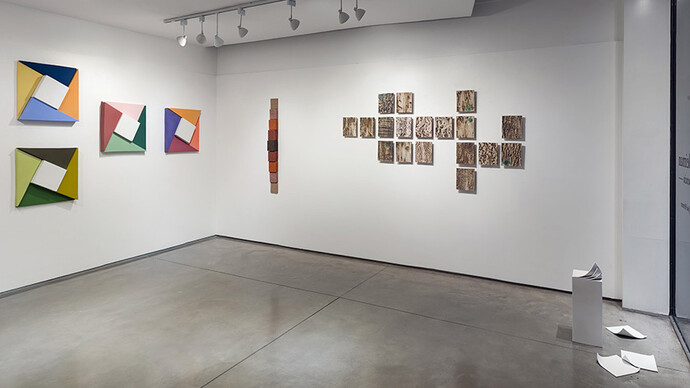
Observation is one of the first actions performed by both a scientist and an artist. To observe implies being able to account for the elements that make up an object or phenomenon—that is, to analyze, to separate, in order to understand how the parts of a whole interact. This was the path taken by Dafne Kleiman, a graphic designer and visual artist, when she moved to live in the countryside: from the stimulating, vibrant city of Buenos Aires to the solitary Uruguayan hills. An introspective experience that undoubtedly led her to reflect on her surroundings and to channel all the conceptual background she had acquired through her profession. Trained at the University of Buenos Aires and later within the geometric tradition of master Joaquín Torres-García, Kleiman understands the syntax of forms and colors as informed both by the Bauhaus experience and by other resonances that Torres-García reintroduced into that strictly functional universe. With the passing of days—marked by the cadence of light through the seasons, beyond the control of the clock—the artist opened her eyes and mind to empirically reconstruct what she already knew: the infinite transitions from warm to cool at sunset on the horizon, the inevitable decay of leaves and their renewal in countless greens, the vibration of the wind across the land, the sounds of day and night—in short, the choral phenomenon that constitutes the cycles of nature. Translated into her practice in ceramics, it is earth, water, air, and fire that allow for the emergence of new objects that embody the artist’s perceptions and intuitions. Earth and water are the raw materials; air and fire are the agents of transformation. The kiln—both a physical and symbolic space—is where these changes occur through the artist’s actions and the agency of the materials themselves, a concept rooted in the neo-materialist theories on which Kleiman bases her reflection. Thus, the artist posits the existence of a fifth plane that accompanies the four materials. Indeed, certain scientific-philosophical approaches—such as those of Jane Bennett1 or Rupert Sheldrake—question the entrenched anthropocentrism that dominated scientific paradigms until the 20th century. The present century has brought a revision of these concepts and of the distinction between the human and the non-human. As a result, matter is now described as “vibrant” (Bennett), much like the essence of living beings. From this perspective, supported by experimentation, objects, animals, and plants—historically considered devoid of consciousness—are revealed as “actants”: sources of action that possess efficacy and can alter the course of events2. The concept of the “memory” of matter is further developed by Sheldrake, who suggests that formative causes—from crystals to birds to societies—do not depend solely on universal laws, but that each system refers to a unique “morphic field” containing a collective memory independent of genes. Within Kleiman’s proposal, there exists a quintessence, as she poetically names it: “it is a link, an interval. It is what happens between the works, between color and light, between time and the viewer’s perception. Above all, it is a possibility: that of forging connections through the awareness of belonging to a broader network.” From the perspective of the anthropology of art, Alfred Gell defines the artwork as an “index” of the social relations that made its existence possible. Thus, while the agency of the image—embodied in an object—is the projection of an individual and its effects on the minds of others, it is also the result of social interaction. In this lies its undeniable appeal and its power as an image. The kiln transforms materials. Its high temperature produces a chemical reaction in which clay becomes ceramic, stoneware—an irreversible state. Each color within the extensive range Kleiman employs, for example in Seasonal Becoming, requires a specific formulation of pigments, applied through non-traditional techniques and fired with timing measured to the second. Even so, these precise processes may lead to success or error. The resulting sculptural configurations appear to have been created through the same mechanisms as nature itself. Each element (a geometric abstraction of a leaf) curves slightly, activating the effect of gravity and the gradual decay of vegetal tissue. Color, too, participates in this process: the biocycle through which the leaf slowly and inevitably perishes, decomposes, returns to the earth, and begins the cycle anew—ensuring the richness of the soil. The processes of ceramics are complex and risky, and in the dialogue established between artist and matter, both are undoubtedly transformed. This is evident in Arboretum, an installation preceded by several performances of observation and “sampling” within a park of ferns and species that thrive in pure air. Kleiman imprinted the bark of trees from the Arboretum Lussich3 on the Uruguayan coast, seeking textures and traces of growth—time, memory of seasons, climates, fauna, and flora present on each surface. Without idealization, and with the raw imprint of each trunk, the artist created a “collection of a collection” of the botanical garden and its diversity, including the unpredictable forms of lichens—organisms born from the collaboration between fungus and algae or cyanobacteria. A hybrid born from another hybrid, evoking processes described by Laura Tripaldi4, who refers to such forms as queer identities of the non-human. Kleiman pays homage to the vitality of this ecosystem, in which she sees the convergence of biological, geological, historical, and cultural forces. In another section of the exhibition, Between the Forest and the Sea, the artist again works with clay impressions—this time of stone surfaces: the oldest entities in her environment, formed over geological times beyond human comprehension. Yet they are there—they have always been there. Traditionally considered inert matter, Kleiman prefers to see them as fragments in which the energy of the landscape vibrates. This intrinsic energy is reflected in the ancestral practice of stacking stones—from Stonehenge to local pircas and apachetas, to the pebbles left by walkers today to mark paths or viewpoints. These ancient stones serve as both real and symbolic instruments for signaling human presence in the landscape. “What connects us to nature?” is the question that, like a mantra, guides Kleiman’s artistic search. “My work explores the inescapable relationship between humans and their environment, using morphology and materiality to investigate the connections that bind us to the natural world. Earth, water, air, and fire are ontological to the ceramic process and do not act as mere resources; they function as active agents within a cycle of integration and transformation in my practice.” These processes, and the temporality they entail, lead us to consider the “vast network that exceeds us,” as the artist notes—she who is both witness and human agent of these transformations. Humanity vibrates, in varying proportions and contexts, with the same energy as the materials it uses. Change, decay, loss, and transience are conditions of material existence. It is therefore a matter of humanity ceasing to perceive itself as the center of the universe, and instead embracing a more horizontal relationship with it. Quintessence, through each of its installations, reconstructs the system of relationships that underlies the cultural construct we call landscape—shaped by conventions of representation, social rules, art historical visions, and studies of perception. Fragmented elements (skies, seas, forests) redirect contemplation toward what we know about nature. Undoubtedly, every landscape is abstract, as representation only accounts for part of what is visible. With a clearly analytical approach, Kleiman deconstructs the landscape into its constituent elements and creates conceptual “reduced models”5 of nature, grounded in a relational way of thinking characteristic of her historical moment and its corresponding aesthetic theory. Quintessence is not only the title of the exhibition but also of five works that embody this idea of connection—of the relationship that unites the four elements. Four scalene triangles (with unequal sides) inserted into a square generate an inner square—the fifth element. The triangles, through their diagonals, create a visual effect of rotation and movement. This composition recalls the “pinwheel” of Torres-García—a scheme of four lines, a “generative module”6 that promotes rhythmic movement within the orthogonal grid. With the legacy of Mondrian, Torres-García, and Joseph Albers in mind, Kleiman activates the square through this pinwheel—a symbol of the permanent movement of the universe and of life—bridging art and design. Design, as the search for rational forms (schemes of tonal harmony) that ensure material and symbolic efficacy; and art, as that which arises from lateral thinking, where emotion has its own agency. In this way, the color harmonies Kleiman employs in these works—both static and rotating—are based on the dramatic spectacles nature offers in daily cycles such as sunrise and sunset, always different depending on the season. Objects born from design are linked to functionality, use, and consumption. A trace of this historical and social conception is found in the use of gold as a pigment. Dry, rustic, subdued, yet inherently brilliant as a precious metal, gold serves as a reminder of where society places its notion of value. In this gesture, Kleiman no longer speaks of nature, but of humanity and the materialism that dulls sensitivity to the vibrant diversity of existence. (Text by María José Herrera, March 2026) Notes 1 Jane Bennett, Vibrant matter: a political ecology of things, Buenos Aires, Caja Negra Editora, 2022. 2 Bruno Latour, cited in Bennett, op. cit., p. 11. 3 Founded in 1896 by Antonio Lussich, it is located in Punta Ballena, 15 km from Punta del Este in the Maldonado department, Uruguay. It brings together hundreds of exotic and native species and is one of the artificial arboretums with the greatest diversity of specimens. 4 Laura Tripaldi, Parallel minds: discovering the intelligence of materials, Buenos Aires, Caja Negra, 2023. 5 For Claude Lévi-Strauss, art is a reduced model of reality. 6 Ricardo Pickenhyan, Nadayave: metaphysics of universal art, p. 321.
Details
Recommended events

Reggaeton Times Square Friday
UPCOMING EVENTS! - GET YOUR TICKETS HERE! UPCOMING EVENTS! - GET YOUR TICKETS HERE! Ryan Castro Night! A Night Dedicated…


Tallinn Derbi: FC Flora vs FCI Levadia
The Tallinn Derby is coming! On Saturday, 13 June at 19:00, A. Le Coq Arena will once again host the…

Aterciopelados
live tonite presents Colombia's rock legends Aterciopelados live in Copenhagen on 01 October 2026 at Pumpehuset from 08 PM Aterciopelados,…
